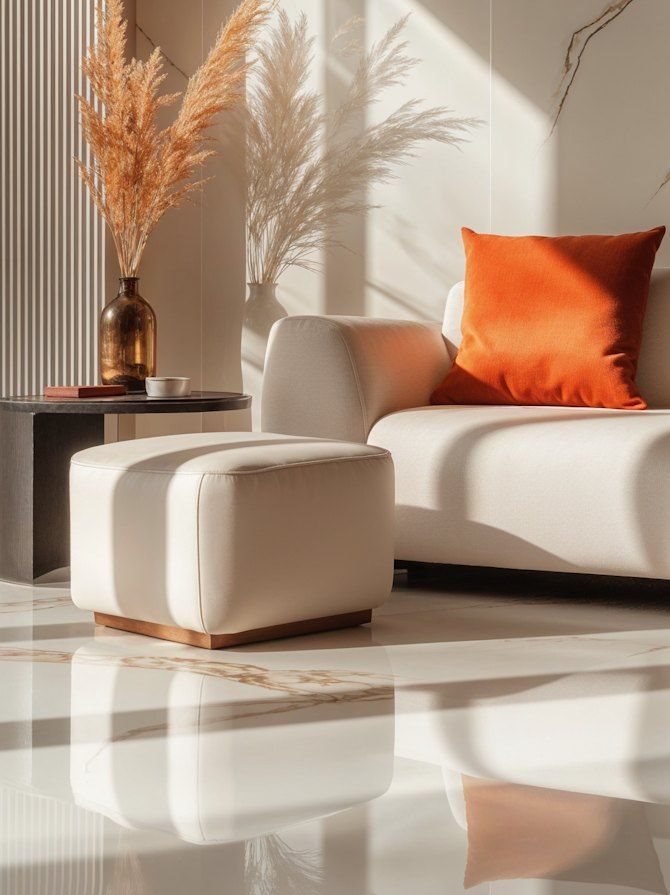
Arches, terrazzo and furniture that looks like scaled-up toys; these are the elements taking over interiors all over the world. After years of Scandinavian modesty and domesticated minimalism, they are like a shot of fresh energy, reminding us that design is fun. Fun with a long history, worth recalling before we reach for the hottest hits on the market.
Ladies and gentlemen - may we present one of the most rebellious and surprising phenomena in the world of design. The Memphis Group!
Half in jest, half in earnest
December 1980, Milan.
During a Friday get-together over wine, the host, Ettore Sottsass, says the words that set off an avalanche of events:
When I was young, all I ever heard was functionalism, functionalism and more functionalism. It isn't enough. Design should also be sensual and exciting.
The guests, young designers clearly weary of Ludwig Mies van der Rohe's maxim drummed into them at university, feel that someone has finally said what they themselves hadn't had the courage to put into words. They start giving free rein to their imagination and chanting:
More is more! Less is a bore!
Breaking free of good taste
Excited, they talk about a world in which reality is no longer confined by modernist frameworks. In the background, Bob Dylan's song "Stuck Inside of Mobile with the Memphis Blues Again" is playing. It captures the atmosphere of the gathering perfectly: it refers both to Elvis Presley's birthplace and to the capital of ancient Egypt - Memphis, ruled by the pharaoh Menes.
The first united millions of fans around the world. The second - Upper and Lower Egypt. Two cults. Two icons. Thousands of years apart, they bracket everything that is fizzing in the guests' heads that evening: extravagance, joy and freedom.
A month after the group is founded, the Memphis members come back to Sottsass with more than a hundred designs. A year later, they are ready for their first exhibition. Only one place will do: the Salone del Mobile. And not just anywhere, but at Mario and Brunella Godani's gallery, a separate space dedicated to objects on the border between design and art.
The world needed it
When Sottsass arrives at the exhibition venue, he is sure a bomb alert has been raised; hundreds of people are milling around in front of the building. In reality, it is an endless queue waiting to get into the gallery. "The New York Times" reports:
Exuberant, seductive and undeniably positive, the group horrified some and amused others, but sent everyone into a state of great excitement.
Word of the uncompromising objects that cross the boundaries of good taste spreads like wildfire and draws crowds.
This is how the Memphis Group is born.
This is how the aesthetics of the eighties is born.
Design open to emotions
Ettore Sottsass was a designer who had always been bubbling over with energy. Although he worked in strictly applied art, he smuggled an element of play into every one of his works. His approach to design combined form and functionality with emotions, making a mix that is hard to resist.
A great example is the portable typewriter he designed for the venerable Olivetti brand. Sottsass enclosed the mechanism in a neat case with tempting curves, which looked like a stylish accessory; perfect for a visit to a café or for showing off at an editorial meeting.
What's more, the typewriter was given a red colour reminiscent of lipstick, and a name: Valentine. It was given a personality.
Sensual design
That is exactly how Ettore Sottsass designed. Emotionally, sensually and humanistically.
He also had exceptional charisma, thanks to which his December manifesto instantly rallied other visionaries.
Depending on the period, the Memphis Group was made up of anywhere from a few to several dozen designers from all over the world. The original line-up from the Milan flat included:
- Martine Bedin – a French designer who boldly broke the mould, a master of eclecticism
- Alessandro Mendini – a close collaborator of Sottsass, the author of household objects (including cult designs for Alessi)
- Michele De Lucchi – an Italian designer known for his exceptional lighting designs
- Nathalie Du Pasquier – a French graphic artist, the creator of abstract patterns bursting with colour
- George Sowden – a British designer specialising in product design, a master of colour
- Shiro Kuramata – a Japanese designer known for furniture "that isn't there" - openwork and glass forms that enter into a dialogue with space
"A marriage of the Bauhaus and Fisher-Price toys"
That is how one critic described the exhibits that awaited visitors at the Salone del Mobile. He didn't fail to add that it was a shotgun marriage ;)
What did the furniture, or rather the objects, that stirred up so much emotion look like?
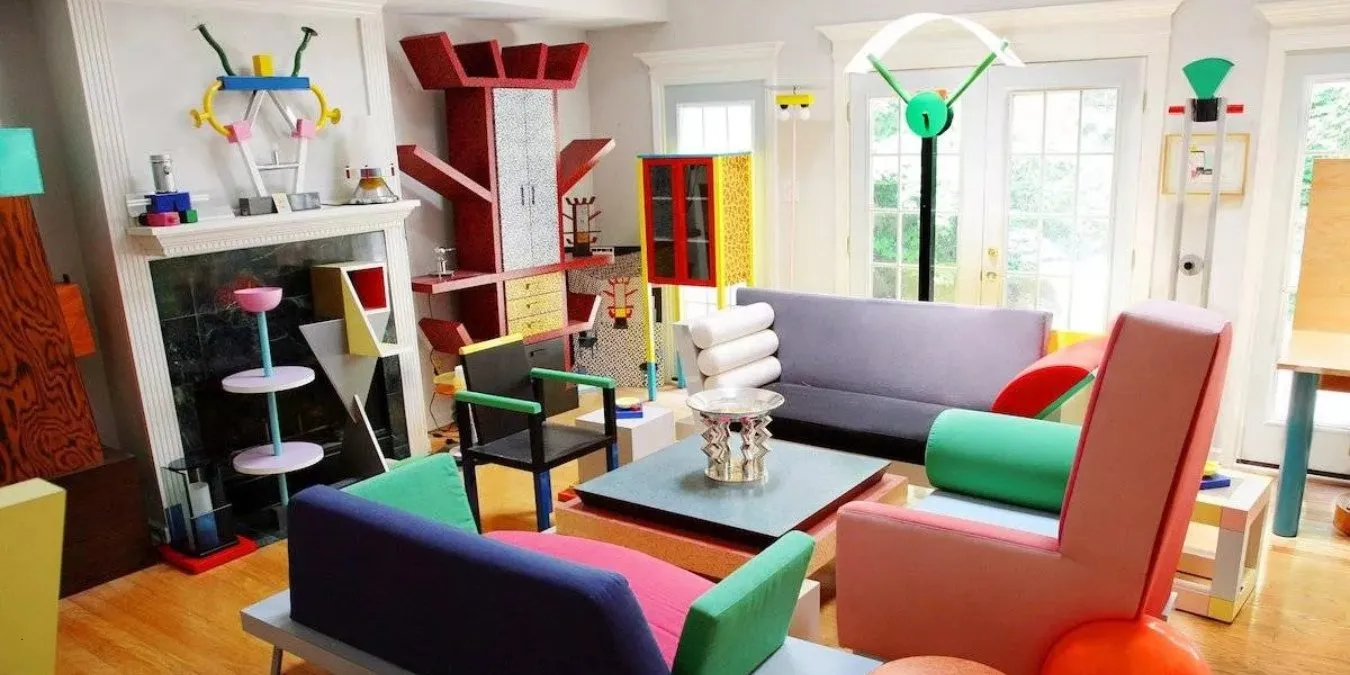
They were like a wink, a joke. They resembled nothing that had been created before. They were strange, wild and…funny. The childlike joy with which they were made encouraged people to take life less seriously. Memphis Group furniture shamelessly "married" noble veneer and natural stone with cheap materials, e.g. laminate or OSB board. It defied the rules of gravity and scale. Above all, it was DIFFERENT.
Sure, references to Pop Art, Art Deco and the kitschy aesthetics of the 1950s were visible, but the Memphis Group's designs created a completely new quality and challenged the traditional understanding of aesthetics.
Design and MTV, or the birth of a new world
The Memphis Group was not the only supernova to debut in 1981.
At the same time as the crazy collective, MTV was taking its first steps - a phenomenon that changed the world of (pop) culture forever. From the very beginning, MTV was associated with a bold aesthetic. The studio, the show intros, even the channel's logo looked like motifs lifted straight from the group's designs. Postmodern aesthetics quickly burst into popular TV series and game shows. It spilled over onto TV studio sets, as well as into trendy restaurants and clubs.
It began to show in fashion - Moschino and Versace led the way, dressing models in geometric outfits bursting with colour. One of the most popular singers of the eighties, Cyndi Lauper, looked like a walking manifesto of the Memphis Group. The outstanding graphic artist and painter Keith Haring filled his socially engaged works with forms referring to the Squiggles pattern.
The trend became a lifestyle.
A ring, a toucan and a goddess. Icons of the Memphis Group
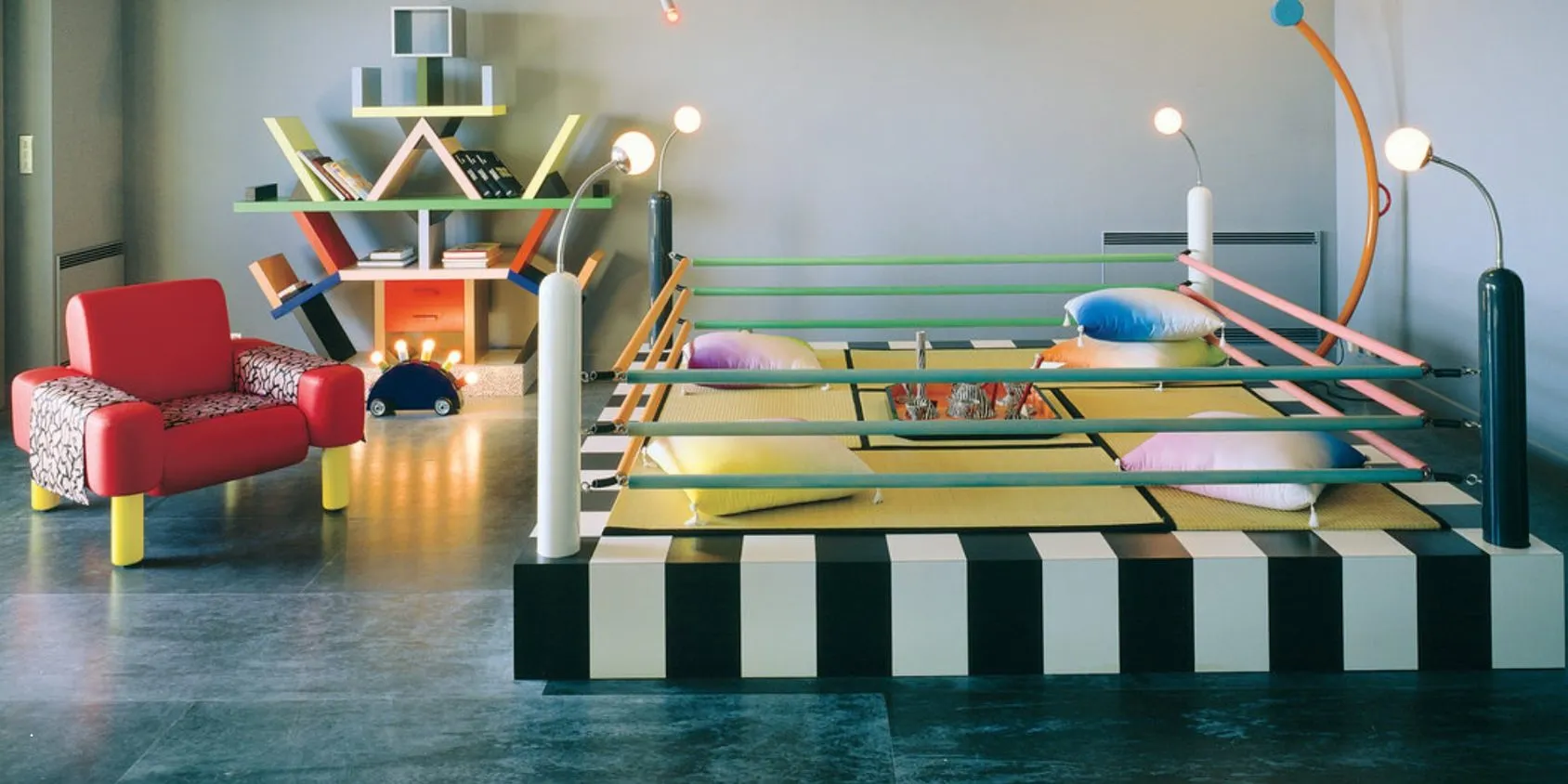
Memphis Group furniture quickly earned the status of design icons and became a colourful object of desire. The greatest fame undoubtedly went to the Carlton bookcase - a multifunctional object on the border between furniture and sculpture. Its totemic form, reminiscent of children's drawings, is topped with the figure of a little man in a victorious pose.
Some claim it is a symbol of the artist-creator. Others bet on a Hindu goddess. The front of the bookcase is covered with the "Squiggles" pattern designed by Sottsass. The wriggling lines and little spirals resemble an image under a microscope, which is why it is more often known as "Bacterio".
A colourful object of desire
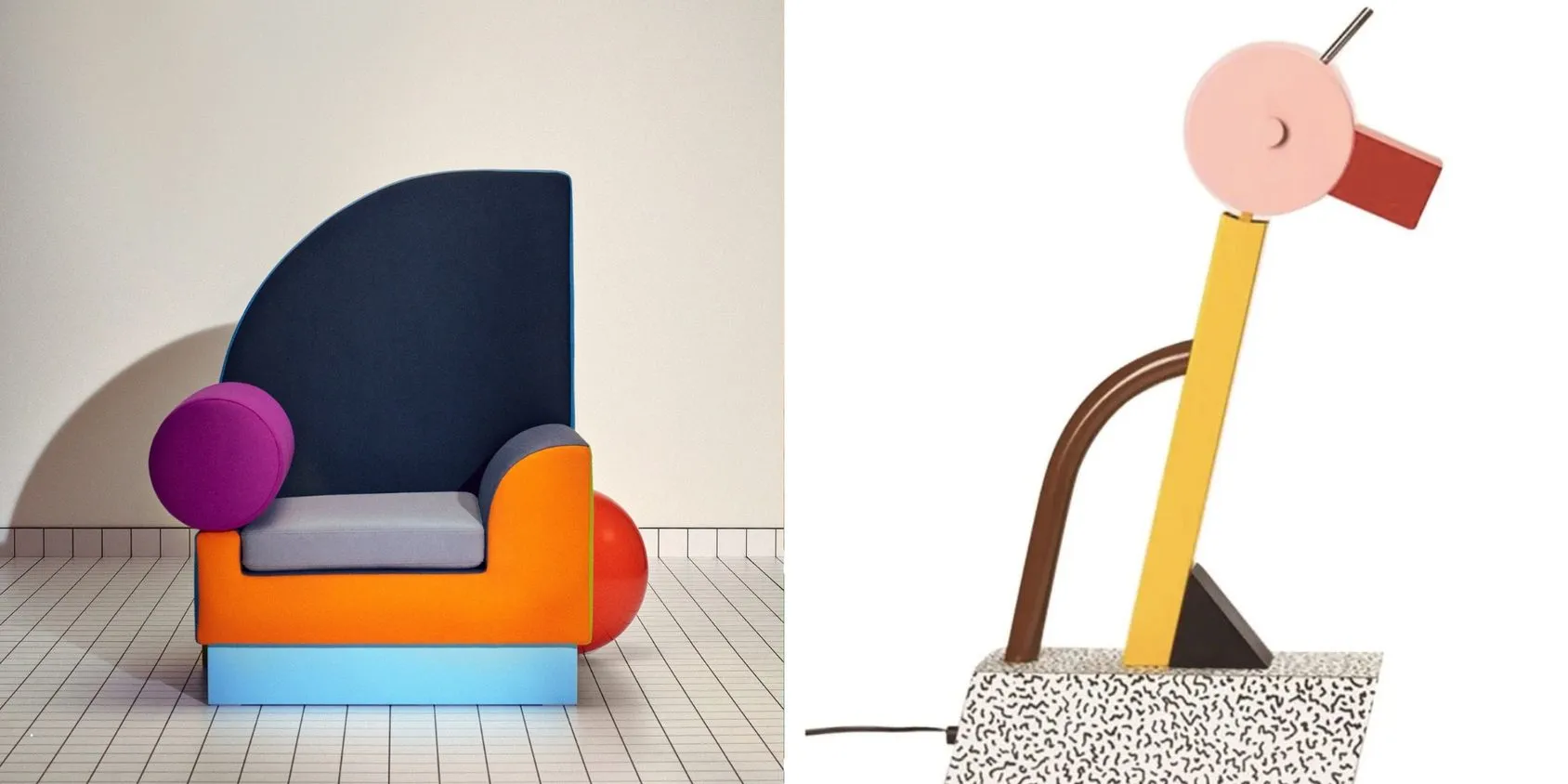
Next came the Bel Air armchair. A variation on a seat resting on a ball, taking a different form from every side. A rounded or an angular seat? A throne or an ordinary chair? Bel Air is an example of a piece of furniture that defies every definition.
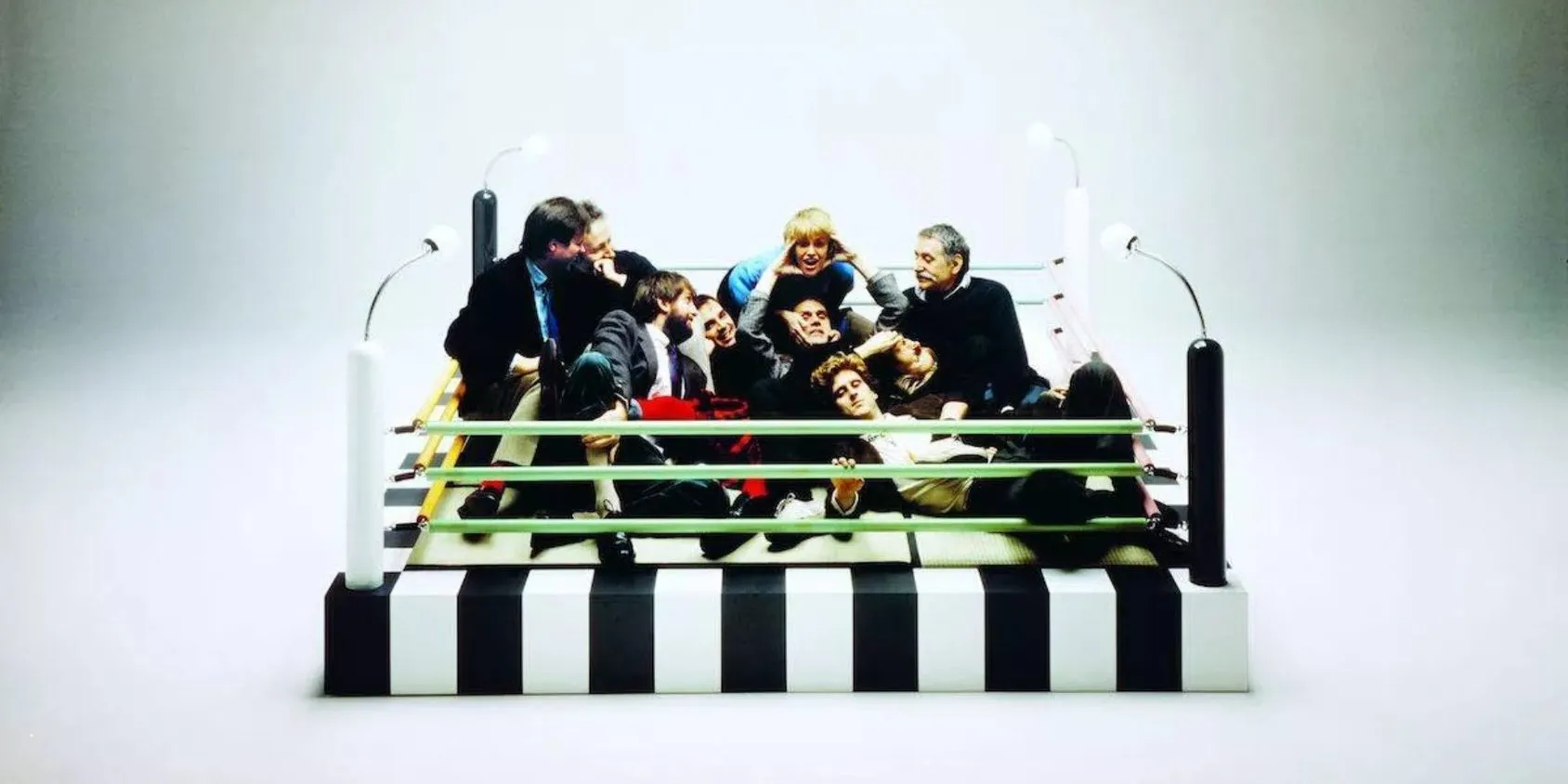
The Tahiti lamp, a minimalist toucan made of slats in tropical colours, surprised everyone with a light bulb in its beak. It looked like a four-year-old's drawing transferred 1:1 into reality. Child's play was also the impulse behind the Tawaraya ring bed; a pillow fight has never been so literal.
Pearls and terrazzo: Chanel meets Memphis
It wasn't only the collective's bizarre furniture that caused astonishment, but also the stories behind it. One of the best-known anecdotes involves Karl Lagerfeld - the fashion world's revelation of the time. Lagerfeld, who had just taken the helm at Chanel, was fascinated by the group's work. So much so that he wanted his apartment in Monaco to be furnished entirely in the Memphis style.
You must be joking, sir
The designers, with their typical sense of humour (but also brutal honesty), tried to talk him out of the idea, explaining that Lagerfeld would go mad in such interiors; he, however, insisted.
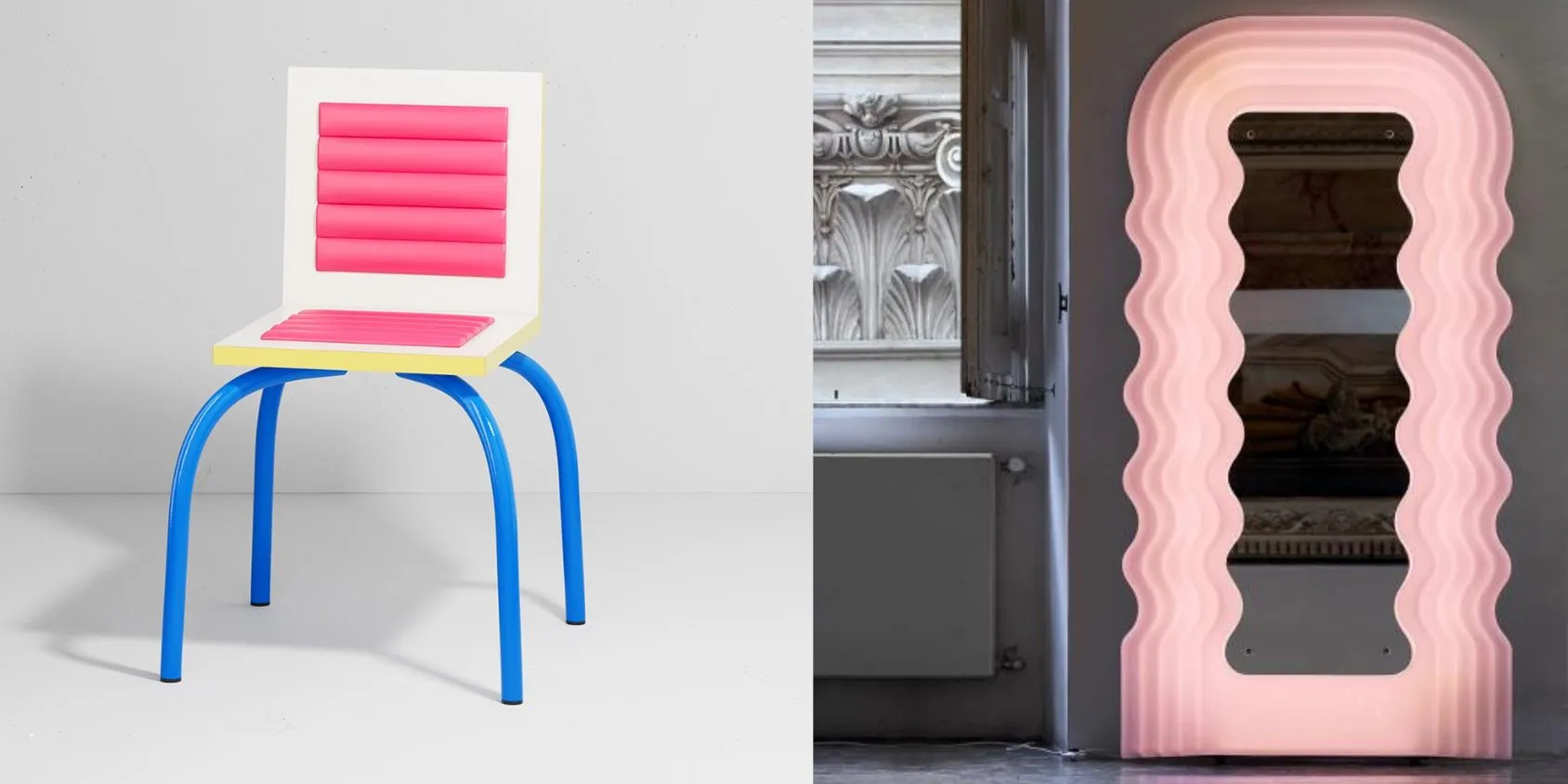
Into the luxurious apartment, filled with marble and crystal mirrors, went the Tawaraya ring bed. The living room was filled with Bel Air armchairs and Michele De Lucchi's Riviera chairs. Lagerfeld, just as the furniture's designers had predicted, lasted a month in such surroundings - after which he had everything packed up and the furnishings replaced. Legend has it that from then on, he furnished all his homes and apartments in a monochrome palette of black and white.
David Bowie likes this!
What happened to the furniture Lagerfeld ordered? We don't know, but what is certain is that if it hasn't been sold yet, it could fetch astronomical sums at auction today. The collective's designs (especially those that never went back into production) are now among the rarest, and therefore the most valuable, objects on the design market.
Officially, the largest private collection of Memphis Group objects belonged to David Bowie. When, in 2016, just after the artist's death, the rumour broke that the collection would be put up for sale at Sotheby's, collectors around the world literally went crazy. The rumour turned out to be true, and the sale of more than 100 objects from the hands of Ettore Sottsass and his companions brought in one million three hundred thousand pounds.
Dressing in postmodernism
Some of the patterns can still be hunted down, e.g. in the Saint Laurent store in Paris. The brand's creative director, Anthony Vaccarello, is a huge fan of the Memphis Group, a passion he gave free rein to when designing the boutique's interiors. And not only then; a few years ago, he created a capsule clothing collection inspired by postmodernism.
It is worth knowing that some of the patterns designed by the Memphis Group are still produced today. The Ultrafragola mirror, made by the Italian brand Poltronova, is hugely popular, for example. Its undulating, pink-lit slabs of frosted glass form one of the most recognisable and sought-after "selfie" frames.
Design that moves you
The veneer created by Ettore Sottsass for ALPI is also still available. It first appeared in his designs in 1985. The striking surface is still in the brand's range today, and top design studios are happy to use it in their projects. One example is the Off-White flagship store in Paris designed by OMA, where the distinctive wood grain stained red and cobalt creates a psychedelic mood.
All good things end too soon
You can use this popular maxim for more than just summing up an empty box of chocolates.
In 1985, Ettore Sottsass left the group. Two years later, the Memphis Group officially ceased its activity. The craze sparked by the collective lasted less than 10 years. Can this be seen as a failure? Absolutely not. It lasted about as long as the Art Deco craze and not much less than Art Nouveau and, like them, it set a direction in art and culture.
There are moments when a lot happens, and then suddenly it stops. Basta. Memphis was like sweets. Too much can make you sick. Ettore Sottsass
To everyone fascinated by the Memphis Group phenomenon, we recommend the book "More Is More" by Claire Bingham, published by teNeues.