The interior designer's assertiveness. Proven ways to develop it.
Surely more than once, despite your inner reluctance, you've taken on a project or a commission that didn't quite match your preferences or principles. Perhaps you've found yourself unable to firmly turn down a client who asked, at 9 pm on a Saturday, for extra visualisations you hadn't agreed on?
Or perhaps you agreed to work with a client even though you could see from the start the potential consequences it might bring, because, say, the husband had a completely different vision from the wife?
Situations like these are part of everyday life in our industry, and a lack of assertiveness and self-confidence becomes a challenge for many of us.
You're not alone in this!
Most interior designers struggle with this problem.
Every one of us has at least once been in a situation where it was hard to say 'no' to a client begging for help.
On the other hand, we know perfectly well that assertiveness and the ability to express our thoughts are key traits and skills an interior designer should have.
They're essential in shaping the terms of a collaboration, but also in defending your own creativity, boundaries and the terms of your contract.

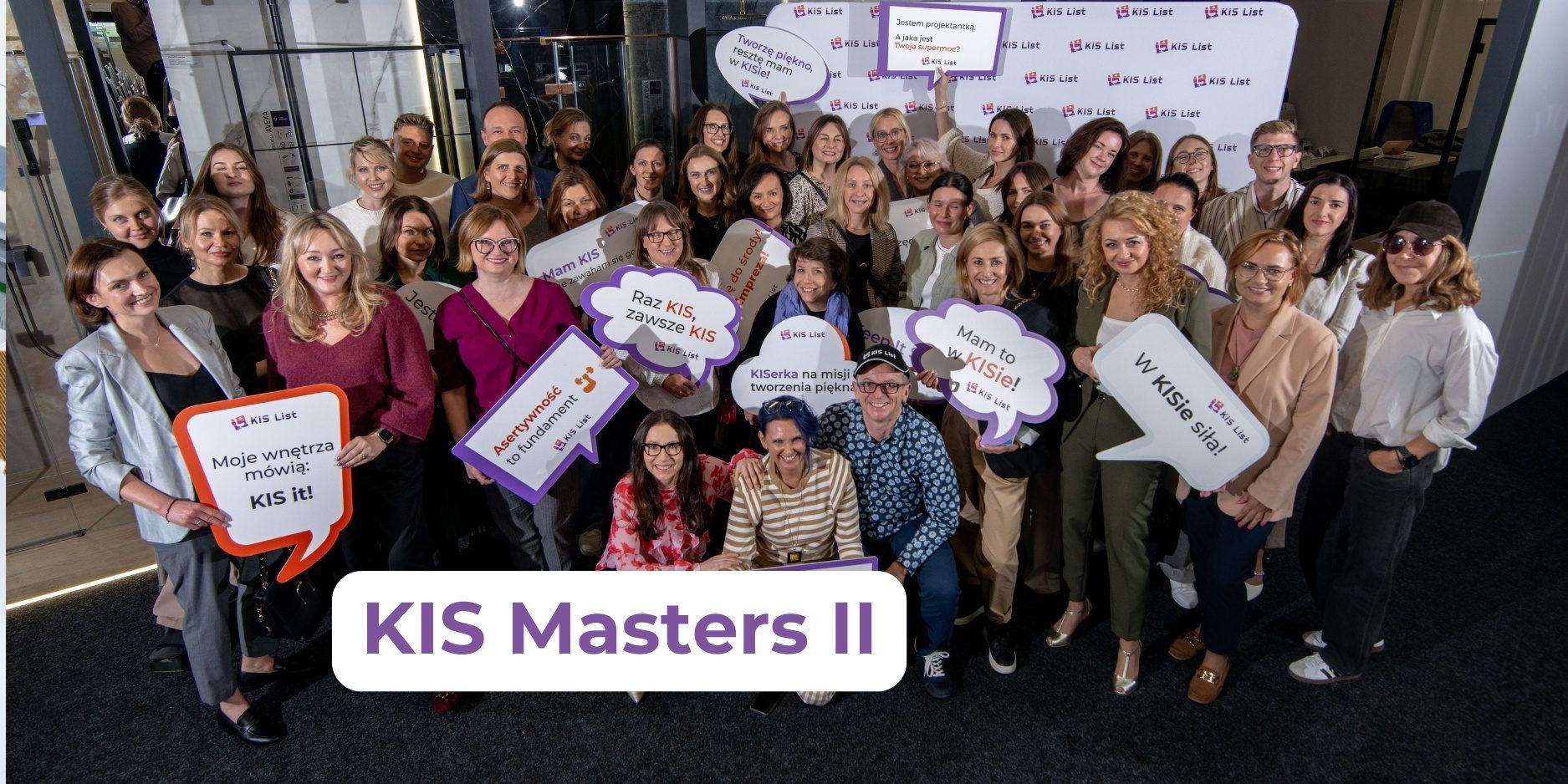
That's why today we'll focus on assertiveness, which we discussed at the first KIS Masters community meeting in November 2023.
Experts such as Agnieszka Pasieka-Adamek, a designer with 16 years of experience and the founder of Akademia Przedsiębiorczego Architekta, and Przemysław Kutnyj, a specialist in public speaking, personal effectiveness and change management, shared their beliefs, insights and advice on how to effectively bring assertiveness and the ability to say "no" into our everyday professional practice.
But why is there such an epidemic of unassertiveness among us – interior designers?
The epidemic of unassertiveness among interior designers - the causes.
Each of us strives to find the happy medium, so that in future we can firmly defend our boundaries and say 'no' without feeling guilty. However, our experience shows that the problem with assertiveness and self-confidence has deeper roots than just the ability to communicate well.
Especially in our industry, where delivering a project involves many different elements – working with the client, the supplier, the contractor.
3 main causes of the epidemic of unassertiveness that stem from the nature of our profession.
The subjective nature of an interior designer's work and the ability to take criticism.
In the interior design profession, every piece of work lets us express ourselves. It's a direct reflection of our personal inspirations and aesthetic vision. In a situation like this, assertiveness can be fleeting.
Each of us, when creating a space, is exposed to subjective judgement, and from there it's only a small step to uncertainty about whether our ideas will be accepted.
What's more, taking a project personally, as a measure of our skills, can lead us to take on commissions that don't convince us from the very start, but the client insists, setting us a challenge.
After all, an interior is an emanation of who we are, so we can't let go, even though we know that sometimes we should refuse and simply say no.

In our work, we often take the client's or contractor's comments very personally, which affects our self-confidence.
For me personally, one of the hard moments for saying "no" to a client and defending my own boundaries came when a client started negotiating the price, arguing that they didn't need certain parts of the project, so it should be cheaper.
And although I could have seen it as an invitation to negotiate, and at the same time as a situation ideal for practising assertiveness, I took it as belittling the value of my work. But it didn't have to be that way.
A client's questions often stem from not knowing the process, which they have every right not to know, especially when it was their first time working with a designer.
However, this is also the moment when we need to look after our boundaries. To open up to criticism, accept our negative emotions and express our own opinion constructively.
But that isn't always easy. After all, nobody wants to feel rejected.
Fear of rejection and the ability to express your thoughts.
Fear of rejection is a significant obstacle in an interior designer's work. It weakens our ability to firmly present our own opinion and to defend our concepts, boundaries and terms of collaboration.
This fear, which often leads to an inability to express our thoughts and therefore to problems with assertiveness, is intensified in the relationship with the client.
Clients' comments, which we may take as referring to our work and which stir up a range of negative and unsettling feelings in us, are often not an expression of their beliefs or criticism, but stem from their lack of knowledge about the design process, and sometimes they are simply an expression of their personal sense of aesthetics.

During the panel discussion, Przemysław Kutnyj pointed out how important it is to assume good intentions in the other person, and therefore in what clients say. On that basis, he encouraged asking follow-up questions, showing understanding and clearing up misunderstandings.
"Remember that you won't always find common ground with everyone. When someone says something to you, always assume their good intentions and ask questions" – he said.
Agnieszka Pasieka-Adamek also stressed how important it is to keep educating clients about the design process and to communicate clearly how the collaboration will run, to avoid misunderstandings or unnecessary conflicts.

Equally important, and helpful in not feeling rejected by a client, is the need to build the awareness that not every client is simply meant for us, just as we aren't meant for every client.
What's more, focusing on the client and their needs at all costs is a trap for our assertiveness.

The client is king, and the race against time.
"Constant phone calls, 100 questions for..., because I found a nice lamp for the living room, because maybe we could change the tiles, because the neighbour has those and loves them, oh and I want a big sofa even though my flat is small…
That, in short, is what conversations with clients look like for many an interior designer. Yes. The client has every right to change their mind. But remember that this is also a big trap for our assertiveness and self-confidence, and an easy one to fall into.
The desire to fulfil the client's vision, sometimes at the expense of our own creativity and design identity, leads us to cross the boundaries of personal comfort and values that we should protect, and it also breeds a sense of being wronged.
Instead of serving the final result of the work, this attitude can lead to losing your own identity in a thicket of compromises and to losing the chance to express yourself in your work.
On top of that, time pressure and constant stress related to tight project deadlines are further challenges we face in our industry.

In conditions like these, it's hard to stay calm, assertive and self-confident.
"And when you add the frustration born of guilt that you agreed to a project you didn't want from the start, stress and illness will wreck you and you'll guarantee yourself sleepless nights. Life's too short" – Agnieszka notes.
Focusing too much on the client is one of the main reasons why even the most talented and experienced designers in our profession, whom we see as assertive people, can suffer from a lack of self-confidence, which can result in a reluctance to take an assertive stance.
Worry about negative judgement, criticism or the fear of losing a client are serious challenges we face as we try to find a balance between meeting clients' expectations and protecting our own boundaries and values.
So the question arises: how do you build assertiveness, and what methods should you use to avoid falling into the trap of being unassertive and sacrificing yourself?

How do you become assertive at work?
Assertiveness is an acquired skill. That means it can be learned. What's more, it isn't just the ability to say "no", but also the ability to accept and express criticism, praise and your own opinions.
Developing an assertive attitude requires conscious behaviour and a deliberate approach both to communication and to our own inner mindset, as well as care for how our work process runs.

Below you'll find the three most important pieces of advice on maintaining and developing assertiveness that came up during the panel discussion at our first KIS Masters community meeting.
These tips will help us in everyday life and in dealing with professional challenges, while letting us develop professionalism and respect both for ourselves and for the other players in the design process.
How do you develop assertiveness?
The ability to say "no" politely.
During our panel, Przemysław Kutnyj shared a method he calls the art of saying "no" politely.
It involves approaching the person we want to say no to, or whose behaviour or crossing of our boundaries we want to point out, from a place of empathy and with the conviction that our intentions are good.
It's our inner conviction that my ideas and professional needs are just as important as the client's expectations that allows us to be assertive and polite towards the client.
For example, your client asks you to take on design supervision of the project, which you hadn't agreed on before. You know that because of other commitments – you're starting another project – you can't agree to it, because it would be bad for you, but also for the client, and would have its consequences. Coming from a place of empathy and with your good intentions, you can tell the client constructively, clearly and confidently that
"I'm very sorry, but unfortunately I can't take on the supervision".
Notice that when you use the art of saying "no" politely, you speak from the "I" perspective, which is very important in communication. Agnieszka Pasieka-Adamek also pointed out that:
"When we say 'no', we often tend to justify our opinion to the client. But you can have many reasons for not wanting to do a particular job, and you don't have to explain them. It's a matter of your respect for yourself, your boundaries and your work."

Przemysław also recommended two books that can help you develop the art of saying "no" politely: "Stanowczo, łagodnie, bez lęku" by Maria Król-Fijewska and "Don't Say Yes When You Want to Say No" by Herbert Fensterheim.
They're valuable reads that can support you on your way to practising assertiveness.
Refer to the facts.
Sometimes even the best intentions and the art of saying "no" politely may not bring the results you expect. In such situations, a precisely worded contract and a clearly defined scope of work, deadlines and terms of collaboration become an invaluable tool.

It's these that give you a clear framework in which you can defend your boundaries and needs, while making it clear to the client how your collaboration will run.
Answering questions from KIS List users, Agnieszka Pasieka-Adamek repeatedly stressed the key importance of a contract: "Contract, contract and, once again, contract".
She also pointed out the importance of keeping all your correspondence with the client, ideally in one file, and confirming everything you agree on by email. Doing this lets you analyse the situation quickly if there's a misunderstanding.
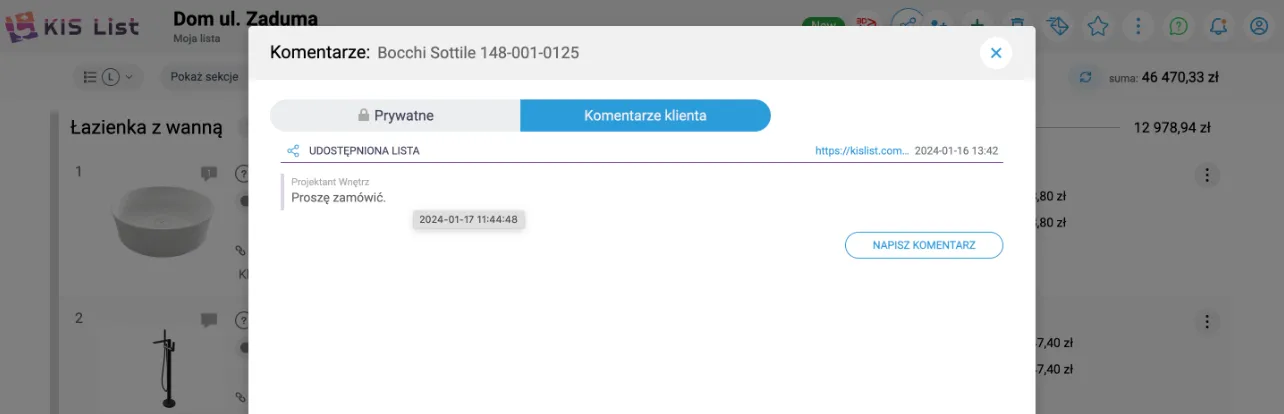
A real-life example from one of the KIS List users – a participant in the KIS Masters meeting – shows how important it is to document everything you agree with the client.
When a client complained a year later about the cabinet front they had chosen themselves, the designer avoided paying for a new cabinet and unnecessary stress by pointing to the comments on the shopping list in KIS List.
By showing them proof that the change to the project was their own wish and had been made at their request, she avoided unpleasant consequences and an unnecessary conflict with the client.
Przemysław Kutnyj supports this view, recommending referring to the facts when an empathetic refusal doesn't work.
"If saying no with empathy doesn't work, you need to refer to the facts".
This is a very important part of developing assertiveness and looking after yourself, especially in our profession, where as interior designers we deliver projects made up of many elements, and their success depends on many other people.
Assertiveness in an interior designer's work covers not only the ability to say "no", but also analysing your work process to identify the elements that can get in the way of effective communication with the client, supplier or contractor.
Your work and time are valuable. Being able to defend your interests professionally and assertively is a sign of professional maturity.

Give yourself the right to refuse.
In our work, we aren't just creators of spaces, but also advocates of our own worth and competence. That's why we shouldn't be afraid to set clear boundaries and realistic expectations for clients, collaborators and even ourselves. We have every right to refuse, and we should use it whenever we feel the need.
It isn't easy.
Agnieszka Pasieka-Adamek, sharing her experience, emphasised that:
turning down a client or setting boundaries with them can raise fears of losing the job, but that's exactly what gives us the freedom to choose who we want to work with and on which projects. It's up to us whether we allow ourselves to say "no" and whether we develop within ourselves the conviction that we have the right to do so.

Przemysław Kutnyj also emphasised the importance of mutual respect and of accepting decisions on both the designer's and the client's side. Both we and the client decide whether we want to work together.
We aren't the best choice for everyone, and not every client will want to work with us, for example because our style doesn't speak to them. And there's nothing wrong with that. It's respect for each other.
Saying no is human. And communicating a refusal, voicing concerns or expressing dissatisfaction is just a challenge we can take on, and one we can also learn.

With passion, without pressure!
Assertiveness in our work is a many-sided topic. It's affected by many factors that stem from the nature of our work. But it's a skill each of us can develop! Let's not be afraid of it! Let's not be afraid to set boundaries! Let's not be afraid to be assertive!
Each of us, whatever our experience, faces situations throughout our lives when it's hard to say "no". So remember that you're not alone in this challenge.

What's more, don't forget that assertiveness is an ongoing process that develops with every experience and project, and developing it lets us achieve harmony between professional satisfaction and personal life.
May your journey to assertiveness be a fascinating route to success, bringing you closer to being the interior designer you've always wanted to be.