A furnishing cost estimate is a list of everything the client will buy for the interior, with the price, quantity, supplier, photo and link, split into rooms and compared with the budget. You start it right after the brief and keep it up to date throughout the project: first as a preliminary estimate with maximum amounts, then with specific products, and finally as the final estimate, which becomes the basis for orders. Below I show what it should include, how to calculate it with a contingency and how to present it to the client for approval - based on my practice as an interior designer.
From a cost estimate in Word to our own tool
I've been an interior designer for 15 years, and for many of them I prepared cost estimates in Word: the product name, a link and the price. When I started out, designers effectively had only Word and Excel for their estimates. Looking back, I can see how many limitations that way of working had.
Checking took a huge amount of time. I had no photos in Word. To check that all the products were right, I clicked every link one by one: a table, then a tap, then a lamp.
Sorting things out for orders was manual. When I placed orders, I copied items, moved them around and added headings. With five rooms, I gathered all the lamps in one place and then spent ages checking whether I had really moved all of them.
The most expensive mistake was the bath screen. The description said the screen should be right-handed, but the link led to a product that was left-handed in the photo. The description was hard to spot, the client didn't read it and bought the wrong screen. Nobody was directly to blame - the document was, because the most important information got lost in it.
Out of these experiences, Robert Czapski, my co-founder, and I created KIS List, a tool for cost estimates and shopping lists for interior designers. Today more than 4,300 design studios use it. Many designers who come to us spent years working in Word and Excel and know the same problems: time lost on copying, checking links and keeping track of versions. Agnieszka Pasieka-Adamek, an interior architect who moved from a spreadsheet to KIS List, writes in her review (in Polish) that she estimates switching has saved her a dozen or more hours a month.
That's why in this guide I describe how to prepare a good cost estimate whatever tool you use: Word, Excel or dedicated software. The key principles are the same.
A furnishing estimate vs a renovation estimate
A renovation estimate is usually prepared by the contractor or a quantity surveyor: labour, building materials and work broken down by trade. A furnishing estimate is prepared by the designer. It covers everything that appears in the design: tiles and flooring, taps and fittings, lighting, furniture and accessories.
The line isn't rigid. Depending on the scope of the designer's service, a furnishing estimate can also include selected building work, priced at average rates. Designers who work to the client's budget even add paint and items you don't normally see: flexi hoses, valves, power supplies.
We've written separately about the cost of fitting out a flat and finishing works, and about talking to the client about the budget.
A cost estimate from the start of the project, not at the end
One of the biggest mistakes is preparing the estimate only when the design is finished. The client falls in love with the visualisations, and then it turns out that the project goes over their budget.
That's why I do the brief first and the estimate straight after it. From the brief I know what the client needs and what their budget is, so I can check right away whether the two match. I wrote about how to gather this information in the article Interior design client questionnaire.
In practice, the estimate goes through three stages:
1. The preliminary estimate: names and maximum amounts
After the brief you don't know the specific products yet, but you know the client's budget and the scope of the project. You enter items by name, with an amount they mustn't exceed, for example:
- sofa - up to €1,500;
- basin mixer tap - up to €200;
- bathroom tiles - up to €35 per m².
The total of these amounts, plus delivery and a contingency, must fit within the client's whole budget. So you plan the contingency from the start, not once all the expenses have been worked out. This way you know straight away how much you can spend on each item, and the client can see whether their budget matches the scope before you start designing.
2. The estimate during design: specific products
As you choose products, you put them in place of the items with maximum amounts. You see the real prices and know immediately whether you're within the allowance. If the sofa comes out more expensive, you look for an alternative before the client sees it and grows fond of it. You show this estimate to the client together with the visualisations.
3. The final estimate: the basis for orders
Once the design is approved, you check every item: the final variant, quantity, dimensions and price. The final estimate becomes the basis for orders - whether you buy the products or the client does.
Before ordering, check the prices, product availability and delivery times once more. Even an approved estimate may need updating if a few weeks have passed since the design was finished.
You don't need three separate documents. It's one estimate that becomes more precise as the project progresses.
What a furnishing cost estimate should include
Each item should have:
- the product name and supplier;
- the catalogue number, so you order exactly that model;
- a photo - without it you have to click every link to check which product it is;
- dimensions, variant and colour, for example "right-handed" or "left-handed";
- quantity and unit: pieces, metres, square metres;
- unit price and VAT rate;
- a link to the product.
Plus, for the estimate as a whole:
- sections by room, with a total for each;
- delivery costs;
- a contingency;
- the budget you compare the total with;
- the status of each item: awaiting the client's decision, approved, ordered, delivered.
Tip from practice
Don't forget the small things. Sockets, switches, handles or curtains cost little individually, but together they can add a fair amount to the budget.
How to calculate a cost estimate: an example
The amounts are illustrative; what matters is the method. Prices include VAT. This is a simplified estimate of a few selected living room items, not a full breakdown of the cost of fitting out the room:
| Item | Quantity | Unit price | Value |
|---|---|---|---|
| Sofa | 1 pc | €1,400 | €1,400 |
| Pendant light | 2 pcs | €180 | €360 |
| Flooring | 25 m² | €30 | €750 |
| Curtains | 2 sets | €140 | €280 |
| Delivery | €100 | ||
| Total | €2,890 | ||
| Contingency 10% | €289 | ||
| Total with contingency | €3,179 |
The client's budget for these living room items is €3,300, so they fit.
Calculation rules:
- An item's value is quantity × unit price. For tiles and flooring, calculate the area in m², allow extra for cuts and waste, and then check how many full packs you need to order.
- Calculate in gross prices, including VAT. A private client pays the gross price, while contractors often send net quotes. Convert them before comparing with the budget.
- Add delivery. With several shops, that's easily a hundred euros or more the client usually doesn't think about.
- Leave a contingency. The designers I talk to usually allow 10-15% as a buffer for price changes and unexpected expenses. It's a practice from those conversations, not an industry standard - adjust the contingency to the project and the client.
- Compare with the budget after every change, not once at the end.
How to prepare an interior design cost estimate for your client: step by step
- Create a list for the project and split it into sections by room.
- Enter the client's budget and the preliminary items with maximum amounts.
- Replace items with specific products as you choose them. Save them straight away, so you don't have to look for the same table again later.
- Complete each item: quantity, dimensions, variant, VAT. Especially the variant - right or left, matt or gloss.
- Calculate section totals, delivery and contingency and compare them with the budget. If the bathroom goes over its share, you look for an alternative now, not after the presentation.
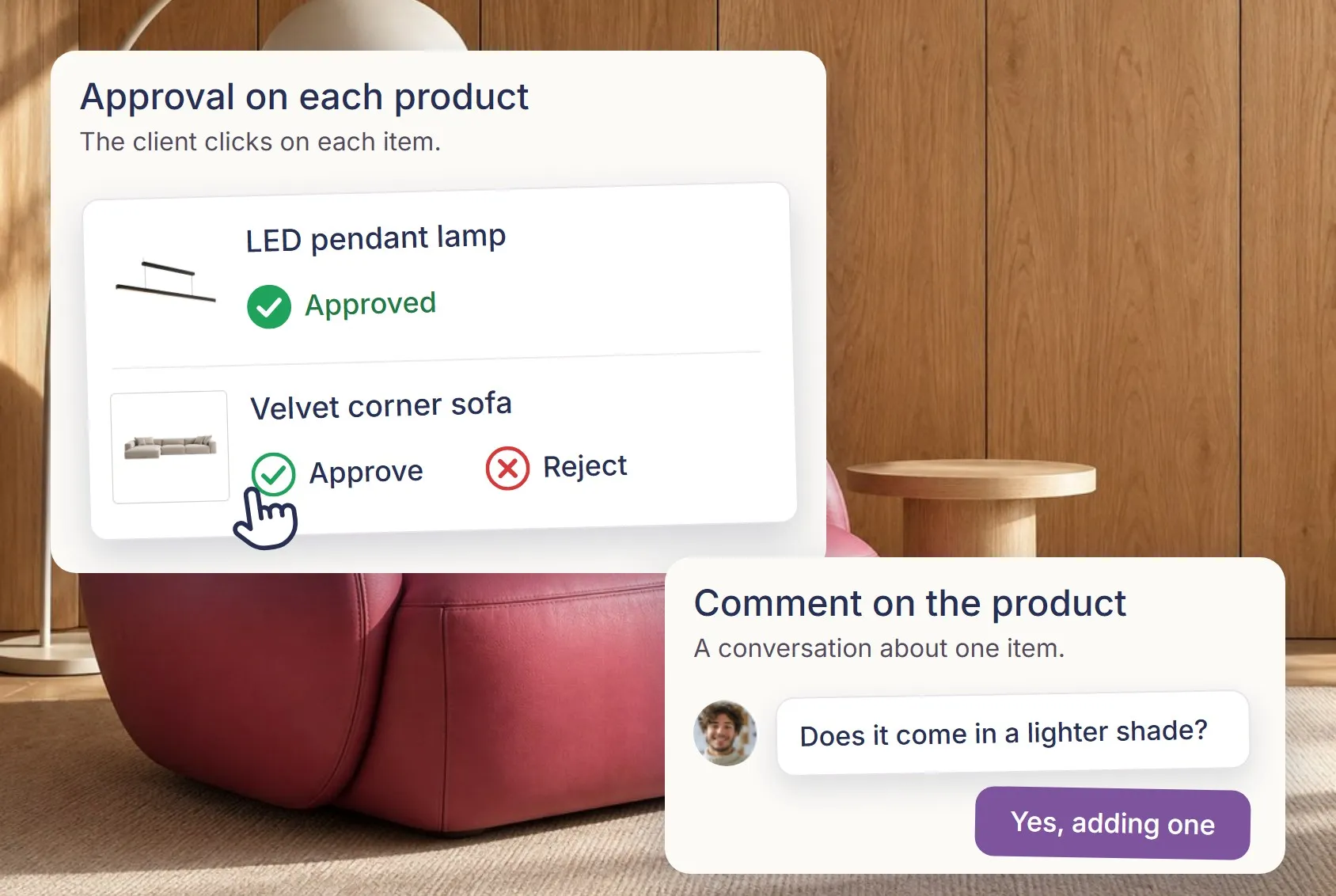
- Show the estimate to the client together with the visualisations, and collect approvals item by item.
- Keep statuses up to date after approval: out for quote, ordered, delivered. The final estimate becomes the shopping list - for you or for the client.
How to present the estimate so your client approves it
Clients don't read an estimate the way a designer does. They look for the photo, the price and the answer to one question: does it fit the budget? So:
- show a photo next to every item - the client recognises a product from a photo faster than from its name;
- state the variant and dimensions clearly, not in small print under the link;
- collect approvals for specific products, not a single "ok" by email for the whole list;
- hide what the client doesn't need, for example links to shops if you place the orders;
- set a deadline for the decision, so the list doesn't wait for weeks.
Where to keep your cost estimate
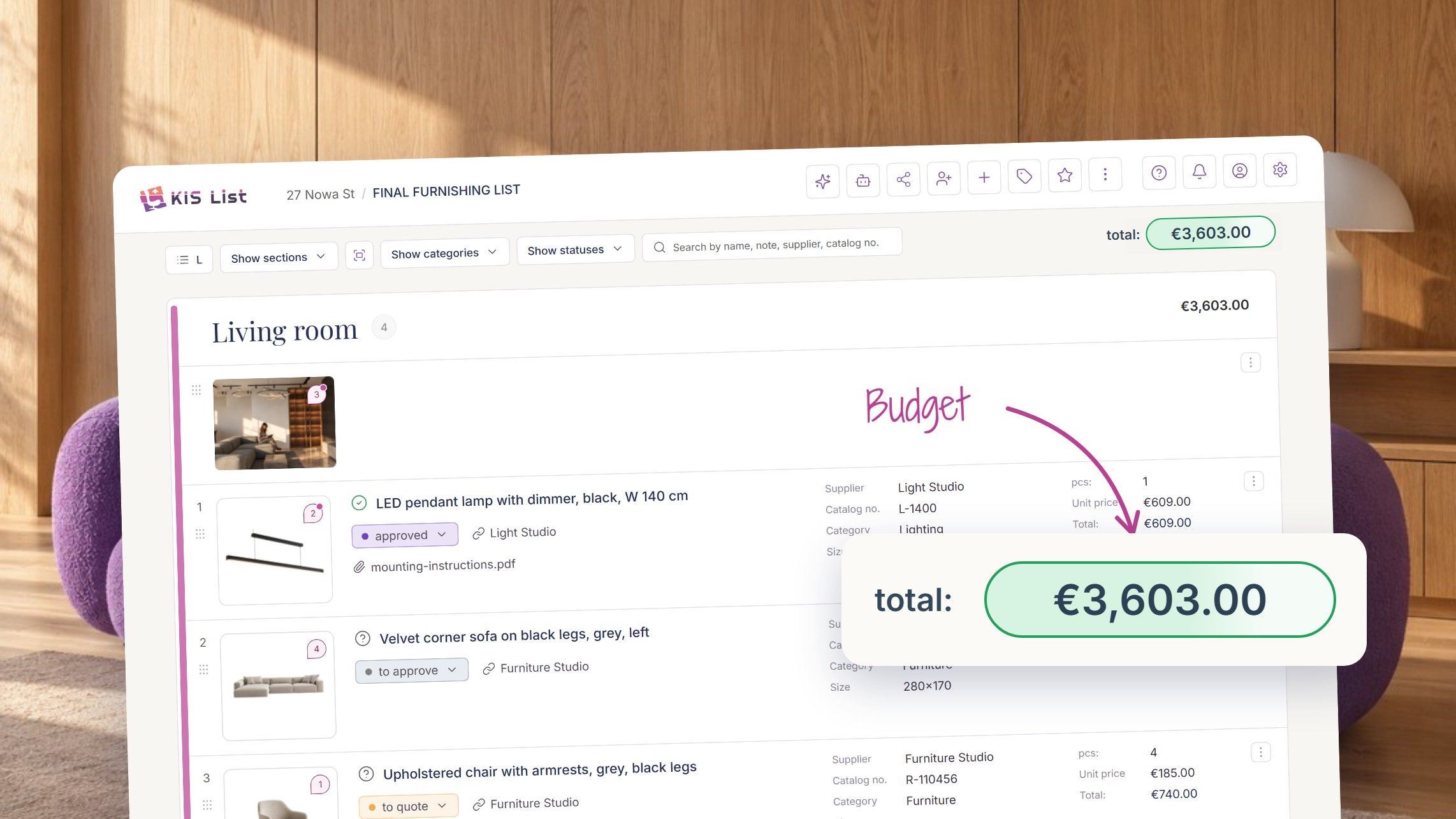
Word and Excel are enough for a small project with a few items. For a whole flat, hundreds of products and clients who change their minds, you need a tool that keeps track of photos, totals, versions and approvals for you. That's what cost estimating software for interior designers does, for example KIS List: you save products from a shop's website with the KISer browser extension, the list calculates room totals and the budget itself, the client approves products in an online proposal, and you export the finished breakdown to PDF or Excel.
The estimate then becomes part of the whole project rather than a separate file: KISjusz can run the client survey, KISaya enhances visualisations with products from the list, and the client sees the estimate, visualisations and schedule in the client panel.
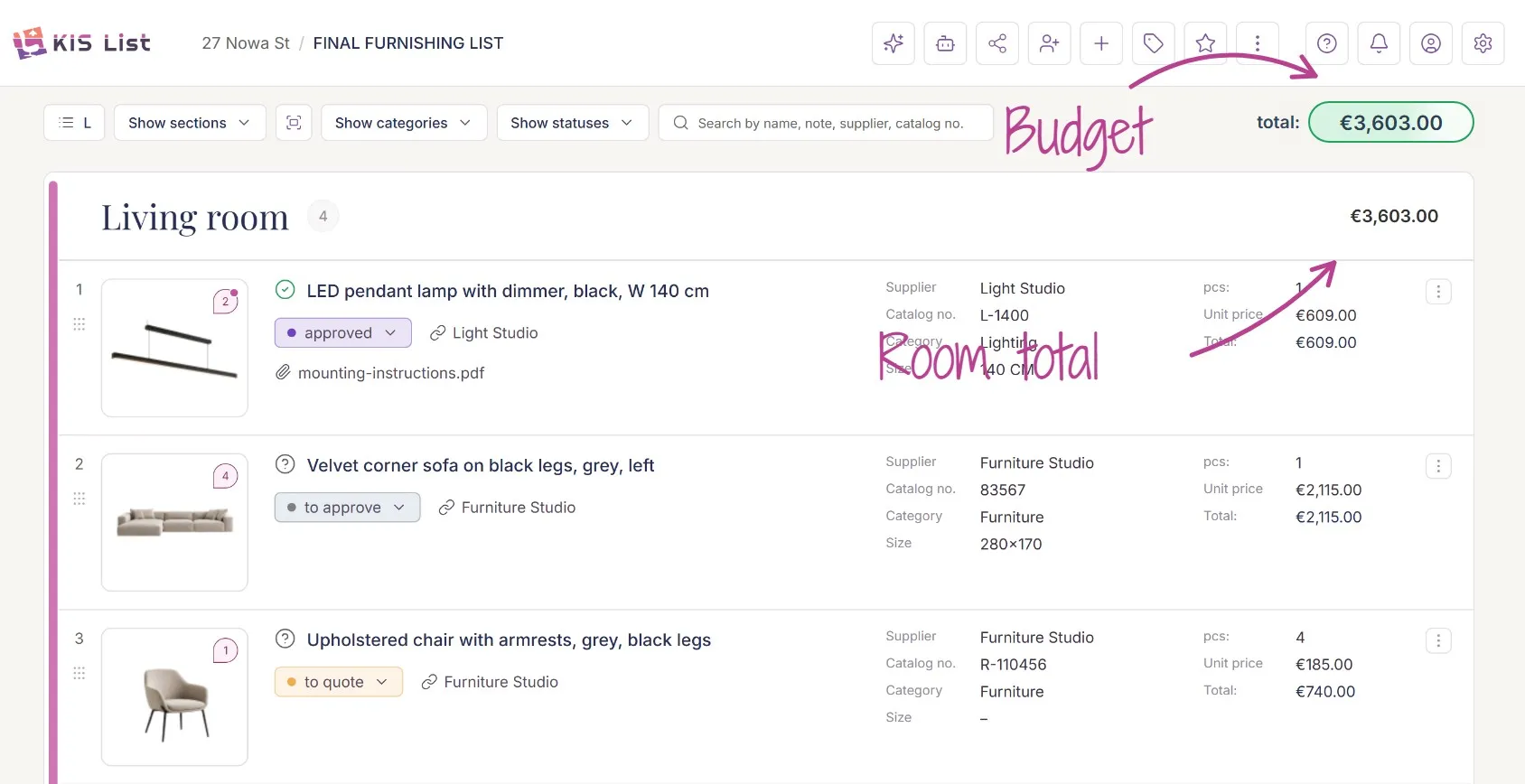
Word, Excel or cost estimating software: a comparison
| Word | Excel or an online spreadsheet | Software for designers (e.g. KIS List) | |
|---|---|---|---|
| Cost | part of an office suite you probably already have | part of an office suite or a free online spreadsheet | from €150 net a year |
| Product photos | by hand | by hand | automatically, with KISer |
| Totals and budget | you calculate them yourself | formulas to set up | section totals and budget straight away |
| Breakdown for a supplier | copying | filters to set up | filter and export in one click |
| Client approvals | by email | in comments or by email | for each product |
| How it looks to the client | your template | your template | PDF with your logo, as a table or a moodboard |
Each of these tools can be used well. The difference is the time you spend on copying by hand, checking links and keeping track of versions.
Frequently asked questions
What should an interior furnishing cost estimate include?
Everything the client will buy for the interior: tiles, flooring, taps and fittings, lighting, furniture and accessories, and depending on the scope of the service, also selected building work at average rates. Each item has a name, supplier, catalogue number, photo, dimensions and variant, quantity, price and link. You add delivery and a contingency to the total.
How does a preliminary estimate differ from a final one?
The preliminary estimate is prepared right after the brief, before you choose products: it lists items by name with a maximum amount, e.g. "sofa - up to €1,500". The final one is the same estimate after the design is approved, with specific products, variants and quantities. It's the basis for orders, whoever does the buying: you or the client.
How much contingency should you leave in an estimate?
The designers I talk to usually allow 10-15% as a buffer for price changes and unexpected expenses. It's a practice, not an industry standard, so adjust the contingency to the project.
Should you show the client links to shops?
It depends on who places the orders. If the client buys the products themselves, links help. If you place the orders, you can hide them. In KIS List you decide this every time you share.
How much does KIS List cost?
The START plan costs €150 net a year, PRO €22 net a month or €220 net a year, and EXPERT €35 net a month or €350 net a year. You can try KIS List free for 14 days, no card needed.
Less to remember, more time to design
A good estimate is one up-to-date list, not five versions in your inbox. Start it right after the brief with maximum amounts, replace them with specific products with a photo and variant, add delivery and a contingency, and collect approvals for specific products. Try cost estimates in KIS List free for 14 days, no card needed.