Don't know where to start?
Have you ever felt so overwhelmed by the number of tasks on your plate that you didn't know where to start? And although you really wanted to get something done, you couldn't focus, and all you felt was stress?
Yes. You've experienced the paralysis that comes from feeling overwhelmed by work.

We manage a wide variety of tasks, deadlines, we create moodboards, visualisations, shopping lists, cost estimates, and on top of that we coordinate the whole project, talk to the client and agree on loads of details.
And that's only a small fraction of our work.
So it's no wonder that, with such a flood of tasks, you can feel pressure and overload that hold you back from getting individual tasks done.
What can you do to avoid this uncomfortable situation that burns us out? How do you protect yourself from paralysis, a growing backlog and the feeling that you've had enough of interior design?
In this article I'll help you find the answers to these questions and share with you proven methods for dealing with a multitude of tasks.

Overwhelm paralysis - what is it?
Overwhelm paralysis is more than ordinary procrastination (putting tasks off until later). Nor is it a matter of lacking motivation to work.
You do have motivation, otherwise you wouldn't have taken on another project. The paralysis comes mainly from the sheer number of tasks to be done and from our inner belief that there are too many of them to cope with.
When you fall into overwhelm paralysis, you find it hard to decide which task to do first to start catching up on your backlog or to get a project going. As a result, the backlog keeps growing, which paralyses you even more and stops you from taking action, even as deadlines approach.
It's an easy state to end up in when you're managing many projects at the same time, when a client asks you for lots of changes to the project or can't decide on individual furnishings.
In our profession it's very easy to fall into this state, because every task demands our maximum attention, creativity and precision.

The destructive loop of unproductivity.
Feeling overwhelmed by work and the paralysis that comes with it are a kind of self-fulfilling prophecy, or in other words a vicious circle. It all starts with an overloaded list of tasks and duties.
When it goes beyond your limit for managing tasks, this destructive loop kicks in. That's when the weight of work becomes the source of the problem.
You feel as if you're stuck in place, and in extreme cases you may even experience stress and anxiety. As a result, you start to put things off, which only makes the situation worse.
For example, you're choosing materials for an elegant bedroom, but you can't decide on anything, which causes further delays.
This professional paralysis can be contagious if you work in a team. And experiencing work overload in itself brings many harmful effects.

The effects of work overload.
Work overload affects every aspect of your life, from your private life to your professional one. It has a big impact on your health and on how satisfied you feel with your work.
This uncomfortable state raises our levels of stress and unease. Constantly putting off tasks and a growing backlog are a fast track to chronic stress, states of unease and even anxiety.
The feeling that you won't manage to complete the tasks that keep piling up can make you feel incompetent or trigger impostor syndrome. You start to doubt your skills, especially when you struggle with basic tasks.
In the end, your income falls and the profitability of your business shrinks. Delays in projects mean delays in payments, the risk of an unhappy client, negative reviews of working with you, and that can quickly undermine your company's financial stability.
At moments like these, it's important to look for ways to break out of the paralysis and break this loop of unproductivity. It isn't always easy. But it is possible!
Below I share with you 5 ways to protect yourself from, or break through, the feeling of being overwhelmed by work.

5 ways to deal with feeling overwhelmed by work
All 5 strategies you can use to deal with feeling overwhelmed by work focus on getting tasks done.
Although this may seem difficult, especially if you're already experiencing this paralysis, don't worry. Put the strategies described here into practice step by step, and remember that introducing new solutions and habits takes time and patience.
1. Gather all the tasks you need to complete into one system.
One of the best ways to break the loop of unproductivity and free yourself from feeling overwhelmed by work is to organise it.
To start putting your task list in order, it's worth choosing a tool right at the beginning (a planning app, a notebook, a calendar) that will help you manage your work in one place and track the progress of your tasks.
As a first step, start by writing down all the tasks you have to complete. This way you'll get an overview of all the tasks that make you feel overwhelmed by work.
You can note down the deadlines next to individual tasks right away, which will let you determine how urgent they are.
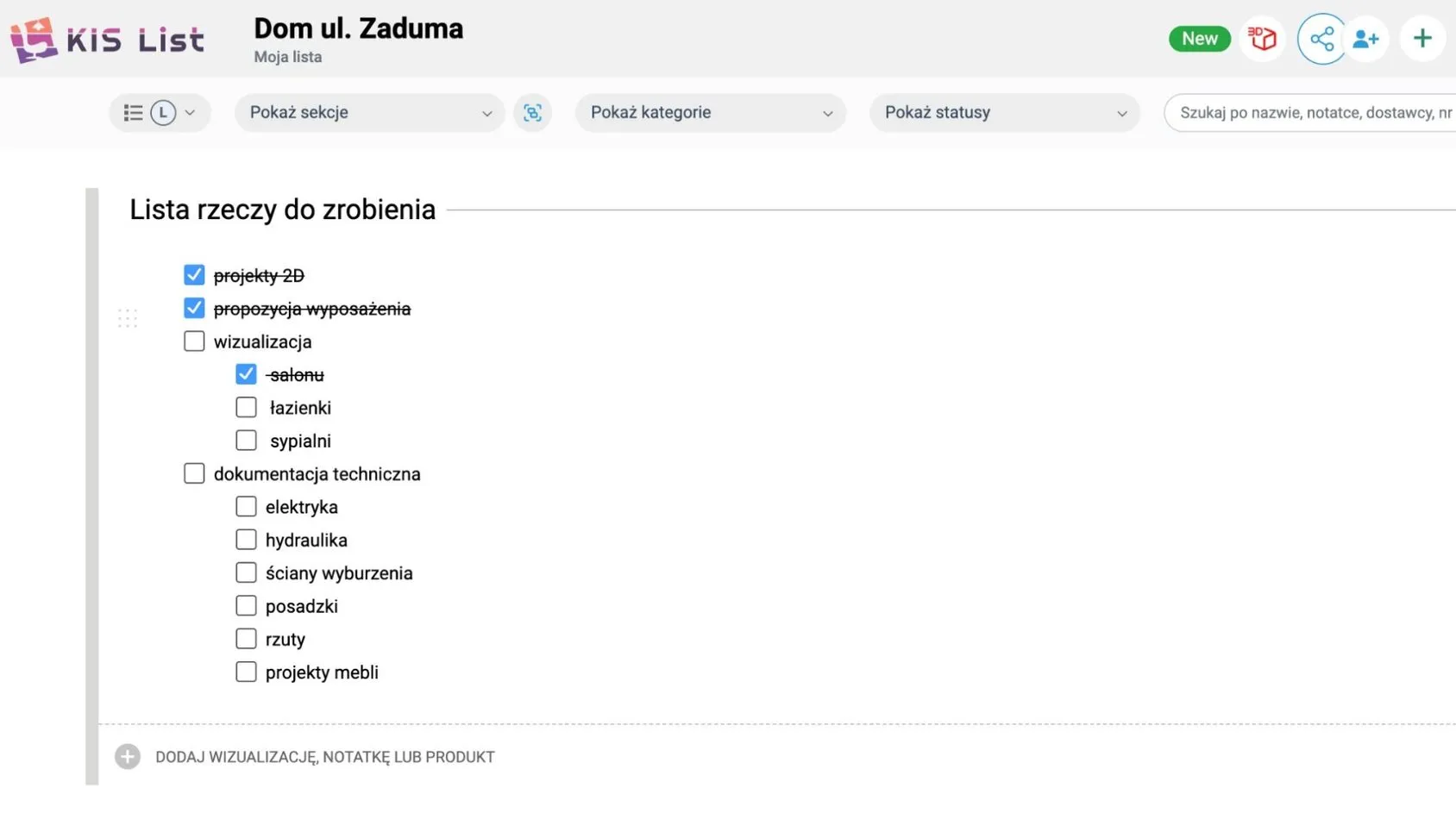
For this, to-do lists, which you can create in the notes field in KIS List, work brilliantly. They let you collect the individual tasks to complete and track your progress by "ticking them off".
Gathering all your tasks in one place is the first and most important step towards freeing yourself from the loop of unproductivity and taking control of your tasks, and with them of your work and your life.
2. Organise your tasks by dividing them into days, weeks or months.
Spreading tasks across individual days, weeks or months lets you visualise the whole process of completing them and place them in time. This is key to keeping balance and efficiency.
Looking at the long list of tasks you created following the first tip, you may feel overwhelmed. But when the same tasks are clearly organised and laid out in a calendar, spread over the whole week or month, your sense of control and calm grows.
What's more, as you tick off completed tasks, your self-confidence grows too, and so does your satisfaction!

Imagine seeing the schedule of your projects in your calendar – from redesigning a living room to a complete kitchen renovation – and watching tasks disappear from the list once they're done.
This not only gives you a greater sense of fulfilment, but also helps you overcome overwhelm paralysis, because you realise that you're in full control of your tasks.
3. Set priorities for individual tasks.
Setting priorities and planning tasks are key elements of task management. With clear priorities you'll know which tasks are urgent and which can wait.
This is another step that will help you structure your task list even further; it reduces the feeling of being overwhelmed and increases your motivation to act.
When prioritising individual tasks, you can rely on various cues that decide whether they carry more or less weight. It might be the task's deadline, its impact on another task or the amount of time you need to spend on it.
For example, if in the coming week you're finalising a living room project for a client, put this task at the top of the list, giving it priority because of its set deadline.
On the other hand, a task such as initial plans for a new commission can get medium priority, because without completing it you won't be able to move further with the project.

Prioritising individual tasks will let you juggle them when something unplanned crops up.
And of course, you'll be able to manage your time even more efficiently, keeping the quality of your projects high while protecting yourself from feeling overwhelmed.
4. Divide and conquer!
Big projects can seem like never-ending lists of tasks that can sit on your to-do list for weeks, leading to a feeling of work overload. So it's worth breaking big tasks into smaller ones, so that they're easier to manage.
Take, for example, a complete interior design project. Instead of treating it as one huge task, break it down into smaller segments:
- the design of individual rooms;
- furniture selection;
- creating the shopping list;
- creating the cost estimate in KIS List;
- lighting planning.
Each of these subtasks can be broken down further into even smaller steps, such as choosing a colour palette for individual rooms or finalising the shopping list in KIS List.

Breaking bigger tasks into smaller ones will not only increase your productivity, but will also help you reduce the stress you feel at the thought of a big project that requires many actions.
Dividing tasks helps you counteract overwhelm paralysis, letting you stay creative and efficient at every stage of the project.
5. Work towards your goal!
A lack of clearly defined goals can encourage procrastination and the feeling of being overwhelmed by work. Without a point of reference, you won't be sure exactly what you're working on and what you're trying to achieve.
That's why it's crucial to set goals that are specific, measurable, achievable, relevant and time-bound.
Goals will keep you on the right track, set the direction of your actions and help you keep a sense of control and purpose.
For example, if your goal is to design a modern living room for a client, first define a specific plan.
It might look like this: I want to finish the project within two months.
So:
- in the first week I need to put together the full brief and take the measurements;
- in the second, prepare the space plan and a preliminary cost estimate in KIS List;
- in the third week…
and so on, until you've set a plan for the two months.

With clearly set and defined goals, you'll not only take control of your work process and organise your tasks even better, but above all you'll be able to watch the process of completing them.
Your confidence in your skills will grow, your motivation will increase, and clients will value you for your efficiency and punctuality.
Don't give in to the pressure!
Pressure and paralysis caused by the large number of tasks we have to complete are common among us interior designers.
Every project demands a lot of commitment, creativity and attention to detail from us, and behind that lies a pile of things to do. That's why each and every one of us is at risk of getting caught in the loop of unproductivity.
The best way to protect yourself from this unpleasant state is to organise your work process well. Because only skilful and efficient task management can protect us from feeling pressure, overload or unproductivity.
I hope my tips will help you streamline your work even further and protect yourself from the burnout that is no stranger to our industry.
And when the feeling of being overwhelmed by work catches up with you and you enter the loop of unproductivity, remember that you're not alone in this. It's a problem many of us share.